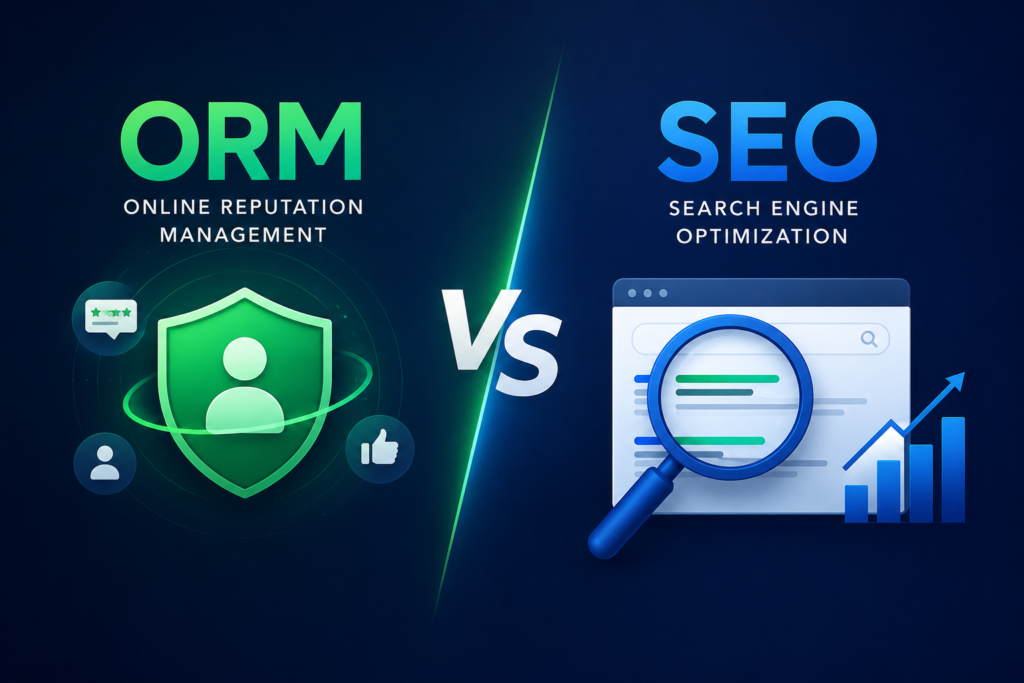
Online Reputation Management vs SEO: What’s the Difference and Why Businesses Need Both
In today’s digital-first world, your online presence can determine whether someone trusts your business, contacts you, or moves on to a competitor. When people search your name, company, or brand on Google, they form an opinion within seconds. That’s where two important digital strategies come into play: Online Reputation Management (ORM) and Search Engine Optimization (SEO).
Although many people confuse ORM and SEO or think they are the same thing, they actually serve different purposes. One focuses on visibility, while the other focuses on perception. Together, they create a powerful foundation for long-term brand growth.
In this blog, we’ll break down the key differences between ORM and SEO, how they work together, and why modern businesses should invest in both. (Check out our service : Repair Reputation , Build Reputation)
What Is SEO?
Search Engine Optimization (SEO) is the process of improving a website’s visibility on search engines like Google. The goal of SEO is to help your website rank higher for relevant keywords so more people can discover your business organically.
For example:
- A dentist in Delhi may want to rank for “best dentist in Delhi”
- A law firm may target “corporate lawyer near me”
- An eCommerce brand may target “buy oversized t-shirts online”
SEO focuses on driving traffic, increasing visibility, and improving rankings.
Main Components of SEO
1. On-Page SEO
This involves optimizing content and pages on your website:
- Keyword optimization
- Meta titles and descriptions
- Internal linking
- Fast-loading pages
- Mobile optimization
2. Off-Page SEO
This includes activities outside your website:
- Backlinks from other websites
- Guest posting
- Brand mentions
- Social signals
3. Technical SEO
Technical improvements help search engines crawl and understand your website:
- Website speed
- Site structure
- Schema markup
- XML sitemaps
- HTTPS security
4. Content SEO
Publishing valuable content helps attract users and rank for more keywords:
- Blogs
- Guides
- Landing pages
- FAQs
SEO is ultimately about increasing organic traffic and improving discoverability.
What Is Online Reputation Management (ORM)?
Online Reputation Management (ORM) is the process of monitoring, improving, and protecting how a person or business appears online.
ORM focuses on:
- Google search results
- Reviews
- News articles
- Social media mentions
- Reddit discussions
- Forum posts
- Blogs
- Videos and public content
The goal is to create a positive online image while reducing the visibility or impact of negative content.
For example:
- A business with bad Google reviews may need ORM
- A CEO facing negative press may require reputation repair
- A company with harmful Reddit threads may want suppression strategies
- A professional wanting better LinkedIn visibility may use personal branding ORM
ORM is about trust, credibility, and public perception.
The Core Difference Between ORM and SEO
The easiest way to understand the difference is:
| SEO | ORM |
|---|---|
| Focuses on rankings and traffic | Focuses on brand perception |
| Helps people find you | Influences what they think about you |
| Targets keywords | Targets reputation |
| Optimizes websites | Optimizes search presence |
| Drives visibility | Builds trust |
SEO asks:
“How can we rank higher?”
ORM asks:
“What will people see when they search us?”
Why People Confuse ORM and SEO
ORM and SEO overlap in many ways because both involve Google search results.
For example:
- ORM uses SEO techniques to rank positive content
- SEO campaigns improve branded search visibility
- Both involve content creation and optimization
However, their intentions are different.
A typical SEO campaign may target:
- “Best digital marketing agency”
- “Affordable web design services”
An ORM campaign may target:
- “Brand name reviews”
- “CEO name”
- “Company complaints”
- “Negative news article suppression”
ORM often uses SEO as a tool, but the objective is reputation control rather than traffic generation.
How ORM Uses SEO Techniques
Many ORM strategies rely heavily on SEO practices. Here’s how:
1. Ranking Positive Content
ORM specialists create positive or neutral content designed to outrank harmful search results.
This may include:
- Press releases
- News features
- Business profiles
- Guest articles
- Social media pages
- Medium articles
- LinkedIn posts
- Blogs
These assets are optimized with SEO techniques so they rank higher on Google.
2. Branded Keyword Optimization
ORM focuses heavily on branded search terms like:
- Company name
- Founder name
- Product name
- “Brand reviews”
- “Brand complaints”
The idea is to dominate branded search results with positive content.
3. Authority Building
SEO authority signals such as backlinks and domain trust help ORM content rank better.
High-authority positive content can push negative content lower in search results.
4. Content Suppression
One major ORM strategy is suppression.
This doesn’t necessarily remove negative content from the internet. Instead, it pushes harmful results lower on Google where fewer people see them.
SEO plays a major role here through:
- Content creation
- Link building
- Optimization
- Indexing strategies
When SEO Alone Is Not Enough
Many businesses invest heavily in SEO but ignore their online reputation.
This creates a dangerous situation.
Imagine:
- Your website ranks #1
- Your ads perform well
- Your traffic increases
But when people search your company name, they see:
- Negative reviews
- Reddit complaints
- Bad press
- Scam accusations
Even with strong SEO, conversions can collapse because trust is damaged.
Visibility without trust is risky.
That’s why ORM is becoming essential for:
- Businesses
- CEOs
- Influencers
- Startups
- Professionals
- Doctors
- Lawyers
- Agencies
- Public figures
When ORM Becomes Critical
ORM becomes especially important in situations like:
Negative News Articles
One viral article can dominate Google results for years.
Bad Reviews
A few negative reviews can reduce customer trust dramatically.
Viral Social Media Backlash
Public criticism spreads quickly across platforms.
Competitor Attacks
Some businesses face fake reviews or malicious campaigns.
Personal Reputation Damage
Professionals may struggle with outdated or harmful content attached to their name.
Reddit and Forum Discussions
Forum discussions often rank highly on Google and influence perception.
The Best Strategy: Combining ORM and SEO
The strongest digital brands combine both SEO and ORM.
Here’s why:
SEO Brings Attention
SEO helps people discover your business.
ORM Protects Conversions
ORM ensures users trust what they see.
Together they:
- Increase traffic
- Improve trust
- Boost conversions
- Protect long-term brand value
Example: ORM + SEO Working Together
Imagine a fitness brand.
SEO Strategy:
- Rank for “best protein powder”
- Publish fitness blogs
- Build backlinks
- Improve website traffic
ORM Strategy:
- Monitor reviews
- Respond to complaints
- Rank positive articles
- Suppress negative Reddit threads
- Improve branded search results
The result:
- Higher visibility
- Better trust
- More sales
Which Is More Important?
The truth is neither SEO nor ORM is more important overall. It depends on the business situation.
If Nobody Can Find You
You need SEO.
If People Don’t Trust You
You need ORM.
Most growing businesses eventually need both.
The Future of Digital Branding
Search behavior is evolving rapidly.
Today, people don’t just visit websites. They research brands deeply before making decisions.
They search:
- Reviews
- Reddit opinions
- News mentions
- Social media discussions
- Founder background
- Employee experiences
Your reputation is now part of your marketing.
That means businesses can no longer treat ORM as optional.
Companies investing early in reputation protection gain:
- Stronger credibility
- Higher conversion rates
- Better customer trust
- More resilience during crises
Final Thoughts
SEO and Online Reputation Management are closely connected but fundamentally different.
SEO helps your brand get discovered.
ORM helps your brand get trusted.
A business may have excellent SEO rankings but still lose customers because of negative search results. Similarly, a business with a great reputation may struggle if nobody can find them online.
The smartest approach is integrating both strategies together.
In a world where Google search results shape first impressions, businesses must focus not only on visibility but also on perception.
Because in the digital age, your reputation often becomes your most valuable asset.
(Check out our services: Monitor Reputation)